Single-Match Funnel · What the Data Supports Changing
Add Certainty Before Payment
The single-match concept engages people — they read the whole page. It dies at the payment button, because everything the buyer needs to be certain of arrives after they pay. Flip that ordering. This report is about that one change: what exactly is uncertain at the button, which fix removes which uncertainty, and how to test it.
16 July 2026 · live DB + data hub · corrected after review
The Finding
They Read Everything. They Stop at the Button.
13 / 16
single-match viewers scrolled past 75% — price, review, everything
1
reached checkout
0
paid through the pay-first CTA (zero booking links minted)
That's not a page being rejected — a rejected page gets bounced, not read to the bottom. It's a page being seriously considered and then declined at the moment of commitment. The interest is real; the offer structure spends it.
And the one buyer the test did produce shows the alternative: a single-match client left the funnel, went to the therapist's profile, picked a time slot first, and paid the same evening (£85). Same person, same therapist, same day, same money — the only difference was that on the profile, certainty came before payment. n=1, so it's a pointer, not proof — but it points exactly where everything else points.
One supporting timing fact: of form-linked buyers, 64% purchase within 3 days. Whatever certainty the page can create, it has to create it in the same sitting — "we'll sort the details after you pay" pushes the resolution outside the window where these buyers act.
The Diagnosis
What the Buyer Knows — and Doesn't — When We Ask for £60
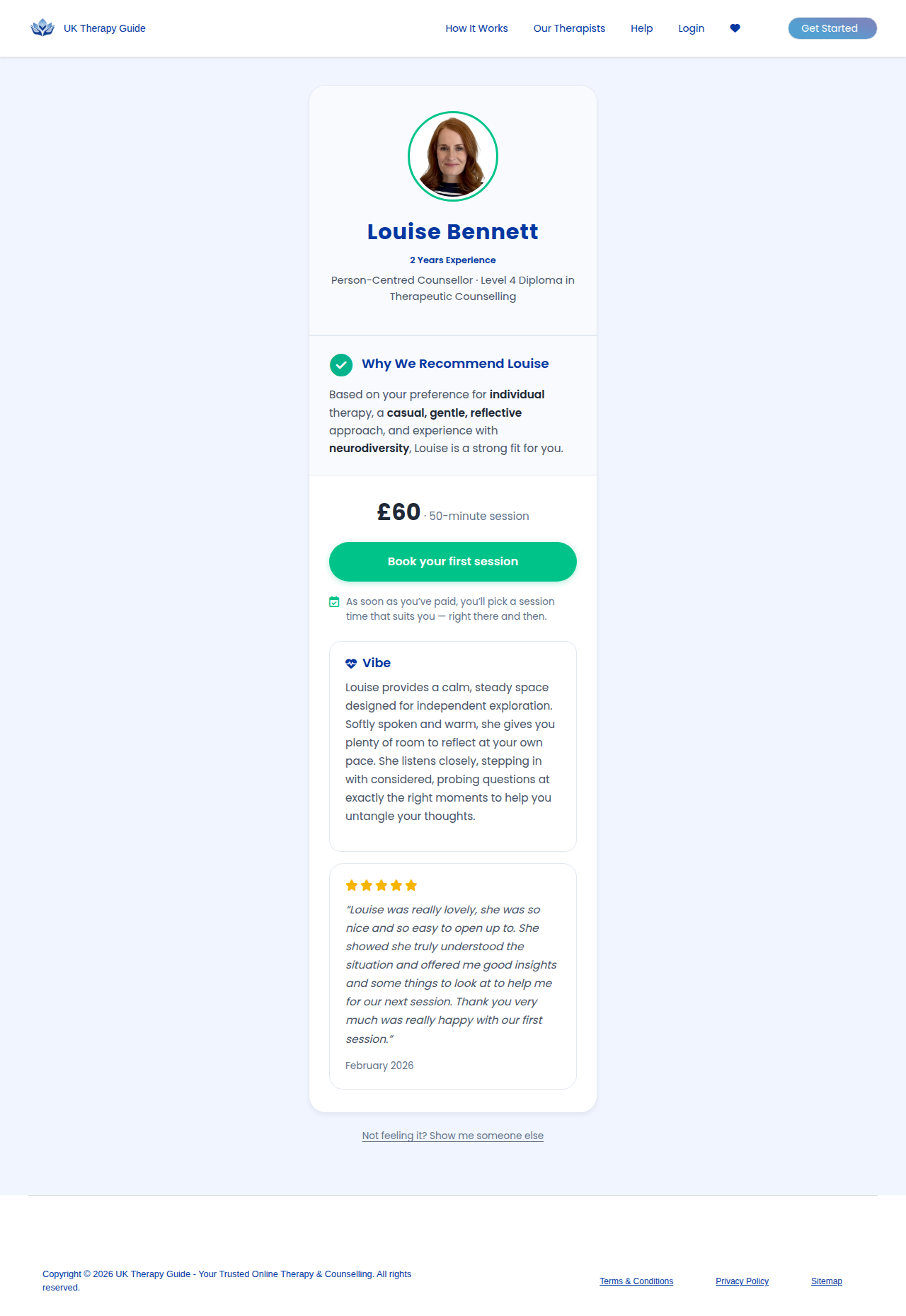
Walk the current single-match page as the buyer. At the moment the green button asks for money, here's the certainty ledger:
THE CURRENT PAGE "As soon as you've paid, you'll pick a session time that suits you" — payment is requested against a promise, with every remaining uncertainty resolved only on the other side of the transaction.
Question in the buyer's head
Answered before the button?
What answers it
Who would I see?
Yes
Name, face, credentials, price, one review — the page does this well. It's why they read to the bottom.
WHEN would I be seen? Is there even a time that works — this week, evenings?
No
Nothing. The calendar only appears after payment. The buyer is asked to pay for an appointment that may not exist in a form they can use.
What if she's not right for me? Is this £60 gone?
No
Nothing. No rematch promise, no visible undo. A wrong pick reads as a total loss — and they were matched by an algorithm they met four minutes ago.
Is this legitimate? Who am I paying, really?
Weak
One quoted review. No Trustpilot, no third-party proof at the decision point.
What exactly happens next?
Vague
"You'll pick a time after paying." A promise about a process they can't see.
One yes, four nos — and the four nos are all the same species: certainty that only exists after payment. Nothing on this page needs to be more persuasive. The information that would close the sale needs to move to the other side of the button.
The Fixes, Ranked
Each Uncertainty Has a Specific, Buildable Answer
1 · Show real times and let them pick BEFORE paying — the big one
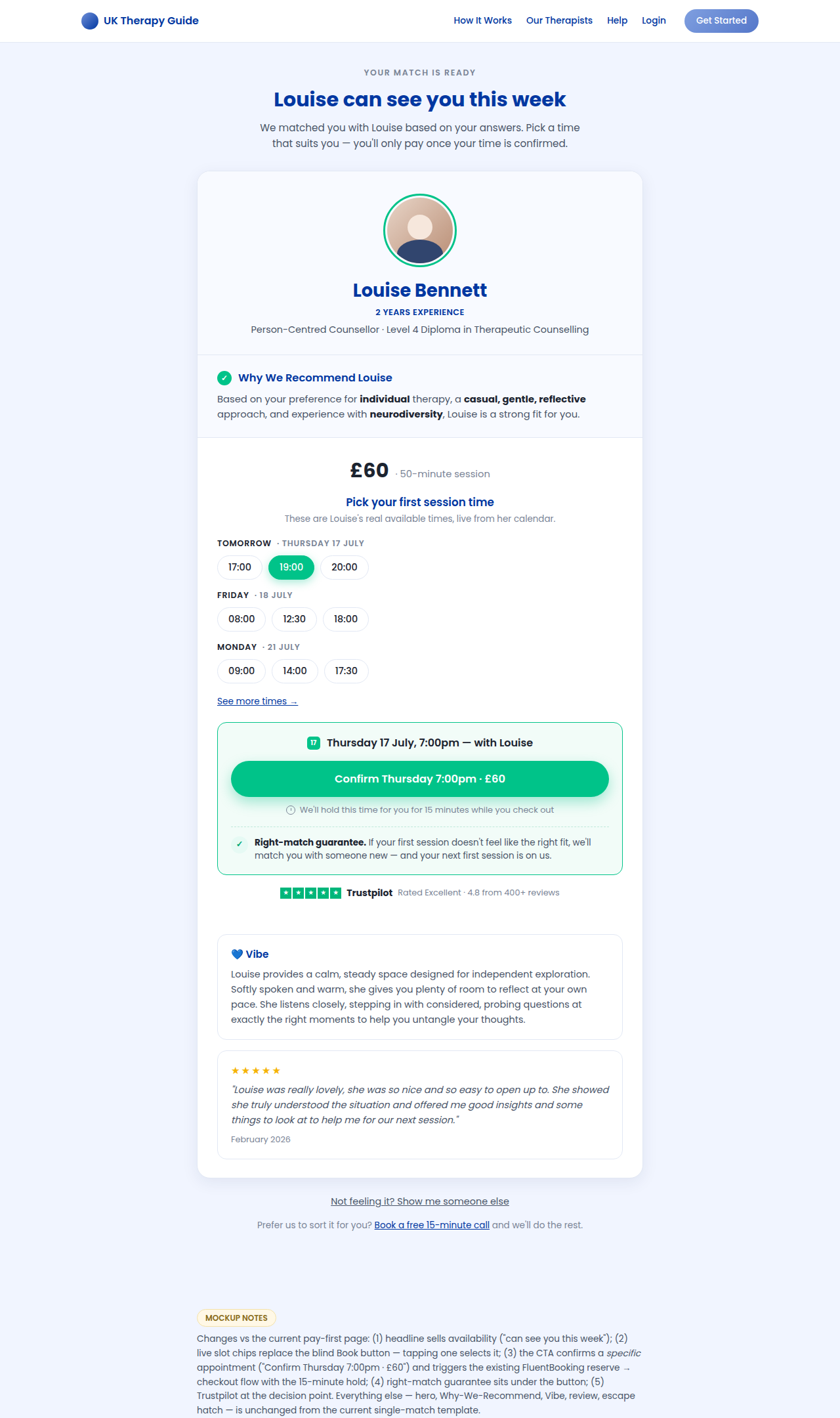
The match card gets the therapist's next real slots ("Emma can see you Thursday 7pm"). Tapping a slot reserves it — FluentBooking's native pending-booking flow, with the 15-minute reservation countdown and cancelled-booking payment gate that shipped last week (UKT-199) — and checkout becomes "confirm Thursday 7pm with Emma · £60".
This one change converts the purchase from a gamble into a confirmation. It kills the WHEN uncertainty and the what-happens-next uncertainty simultaneously, and it puts a concrete, expiring thing in the basket — a reserved appointment — instead of an abstract promise. It also compresses everything into one sitting, where the 3-day buying window says the close has to happen.
THE PROPOSAL — MOCKUP This is the page: "Louise can see you this week" → her real times as tap-to-select chips → "Confirm Thursday 7:00pm · £60" with the 15-minute hold note, the right-match guarantee under the button, and Trustpilot at the decision point. Hero, Why-We-Recommend, Vibe and review are unchanged from the current template. Open the interactive mockup → (the time chips are clickable).
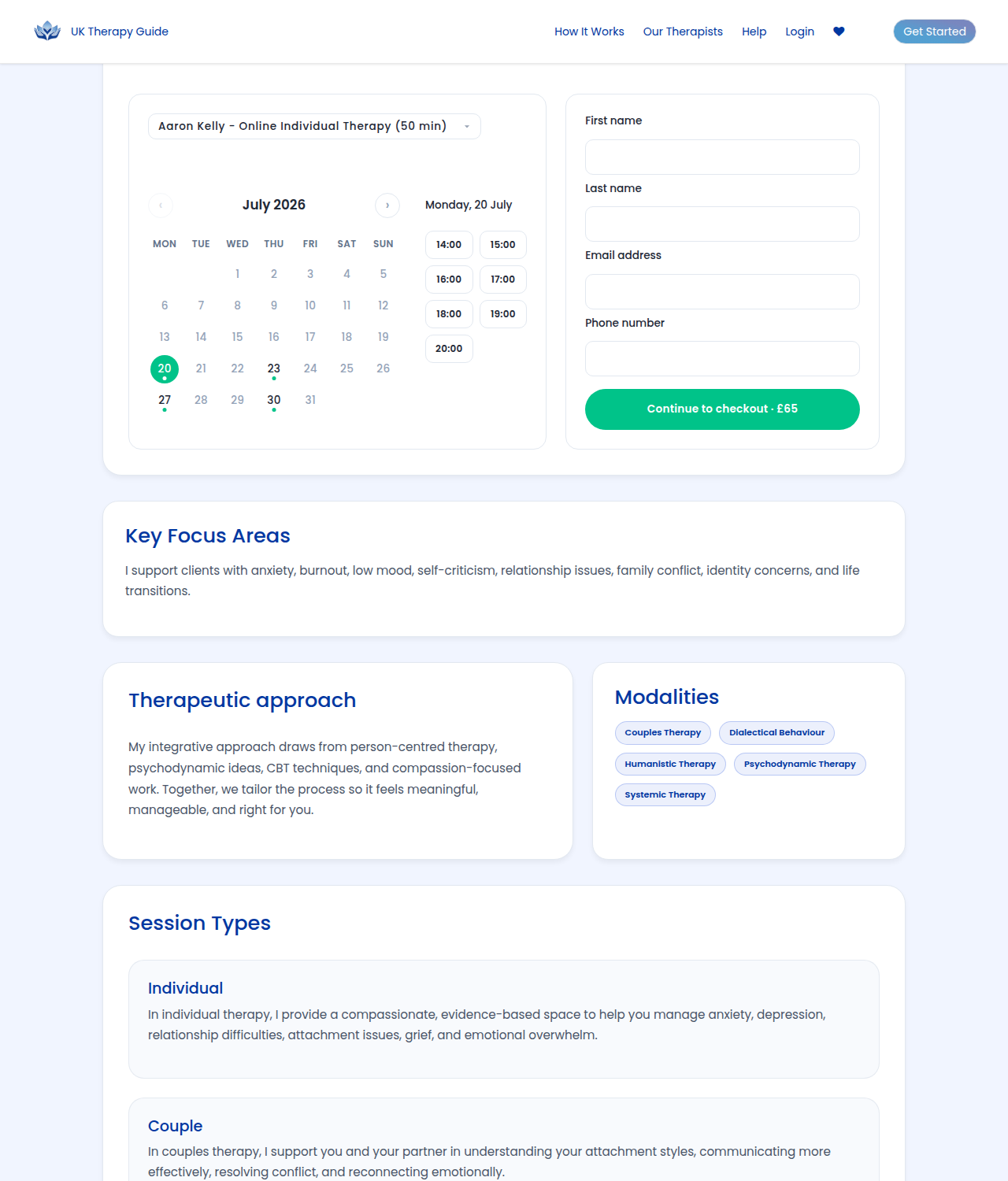
THE MECHANICS ALREADY EXIST The therapist profile already runs exactly this flow — calendar → pick 14:00 → details → "Continue to checkout · £65". This is where Test 9's detour buyer went. The work is wiring the same flow into the single-match card, not building anything new.
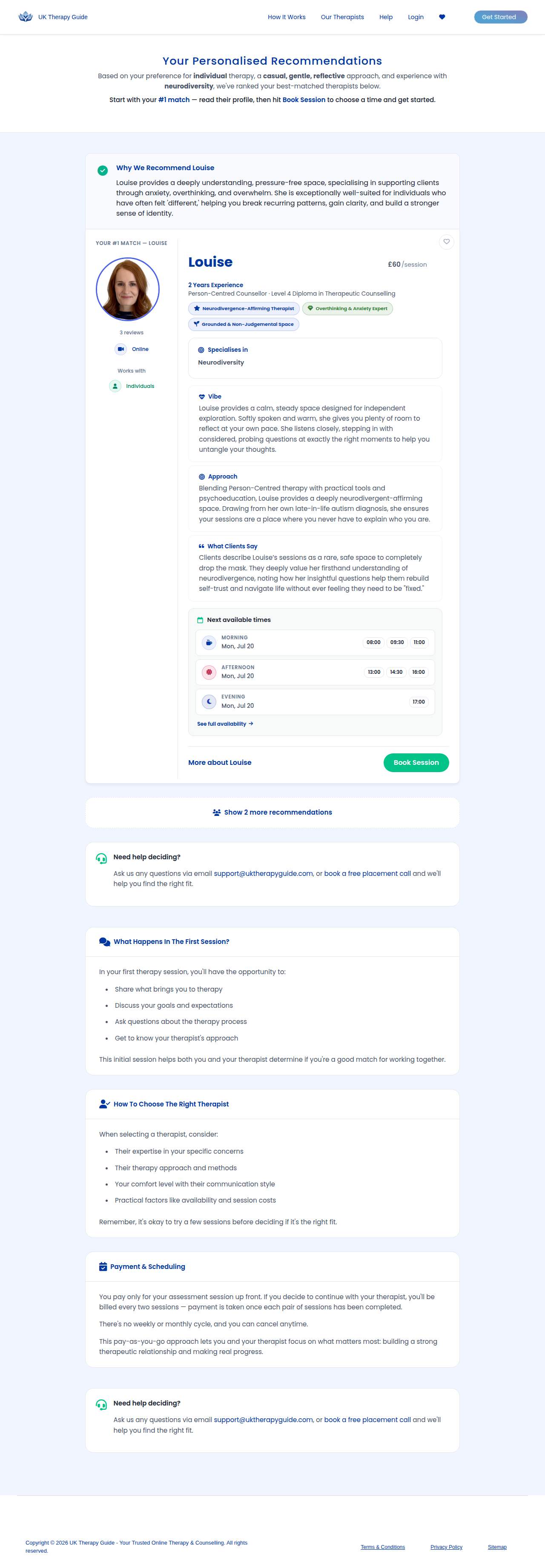
SLOT CHIPS ALREADY RENDER The rec template on the integration branch already shows "Next available times" chips per therapist. The single-match template needs the same chips — with each chip deep-linking into the reserve→pay flow rather than the profile.
2 · A rematch guarantee under the button — kills "what if she's wrong for me"
One line, directly under the pay button: "Not the right fit? We'll rematch you free — and your next first session is on us." This is the certainty the placement team currently provides by existing ("they'll sort it if it goes wrong"), turned into policy. It costs money only on failed matches — clients who today are simply lost — unlike any always-on discount or free session. Needs a business sign-off on the exact promise wording; the honest version of this line is the strongest thing we can put on the page.
3 · Third-party proof at the decision point — kills "is this real"
Trustpilot strip + review count next to the price. Cheap, and currently absent exactly where the money is asked for (the Trustpilot badge is even switched off on the form intro). This is supporting cast, not the fix — but it's near-free.
What NOT to change: the match presentation. The single therapist, the "why we recommend", the price transparency — that part is demonstrably working (the read-through proves it). One variable: the ordering and dressing of the commitment.
Next Test
Slot-First Single Match vs Current Pay-First
Variant: single-match page, identical above the fold, but: slot chips on the match card → tap → slot reserved (countdown) → checkout reads "confirm [day/time] with [name]" → guarantee line + Trustpilot under the button.
Control: the current pay-first single-match arm, unchanged.
Two-week gate (early signal, not verdict): slot-taps and checkout-reached per match view. Current pay-first baseline: 1 checkout per 16 offer views. If slot-first doesn't clearly beat that on intent signals, the certainty thesis is wrong and we stop there.
Verdict metric: email-matched purchases of the arm's own offer (the "Actual Purchases" column — the attribution counters under-read and the Test 4 snapshot proved it). Judge at ~700+ finishers per arm or 6 weeks, whichever first.
Leave the paid-placement arm B running if volume allows — but note its risk profile: it asks for payment before any human contact AND before any certainty, which under this diagnosis is the weakest possible position. Expect it to lose; let the data say so properly this time.
The offer stops being "pay £60 and we'll take it from there" and becomes "Thursday 7pm with Emma is yours — confirm it."
Same therapist, same price, same page. The buyer signs up for a specific appointment instead of an act of faith.
The benchmark. The self-serve rec page did 2.6% (3/115) on the same traffic — the gap lives at the commitment step, nowhere else.
Profit breakeven for self-serve (April model, LUFT halved)
~13.5%
Still the target; unchanged.
New clients via LUFT (data hub, May · June)
98.1% · 95.3%
There is no self-serve channel today — ~5 unassisted profile-flow first purchases in 11 weeks. Slot-first is a hypothesis to test, not a channel to copy. (Corrects the earlier £69k claim, which was repeat clients miscounted.)
Buying window
64% within 3 days of the form
The offer must close in-session.
Tests 5, 6, 8 (directory funnels)
100–650 entries each
Too small to conclude anything; treat as noise, not as "directory disproven".
Test 9 so far (pay-first, both arms)
0 offer purchases
Tiny sample; the read-then-stall shape is the only signal worth taking.
Measurement rules that bit us before: trust only email-matched purchase columns (the Test 4 dashboard snapshot said 0 while 96 buyers existed); ~700–1,100 finishers per arm to detect 2.6%→5%; don't compare form-completion rates between variants that share the same form — it's the same form with a different redirect.